Following the „Dagmar Aaen’s“ arrival on the weekend last week, there has been a further change of crew members. Arved Fuchs is once again on board after the first stage of the journey on the Bissagos Islands and has taken over the ship from Volker Wenzel. Fuchs arrived together with Fabian Schlüssel und Michael Stockmann in the capital city of the province Tierra del Fuego and got a quick overview.
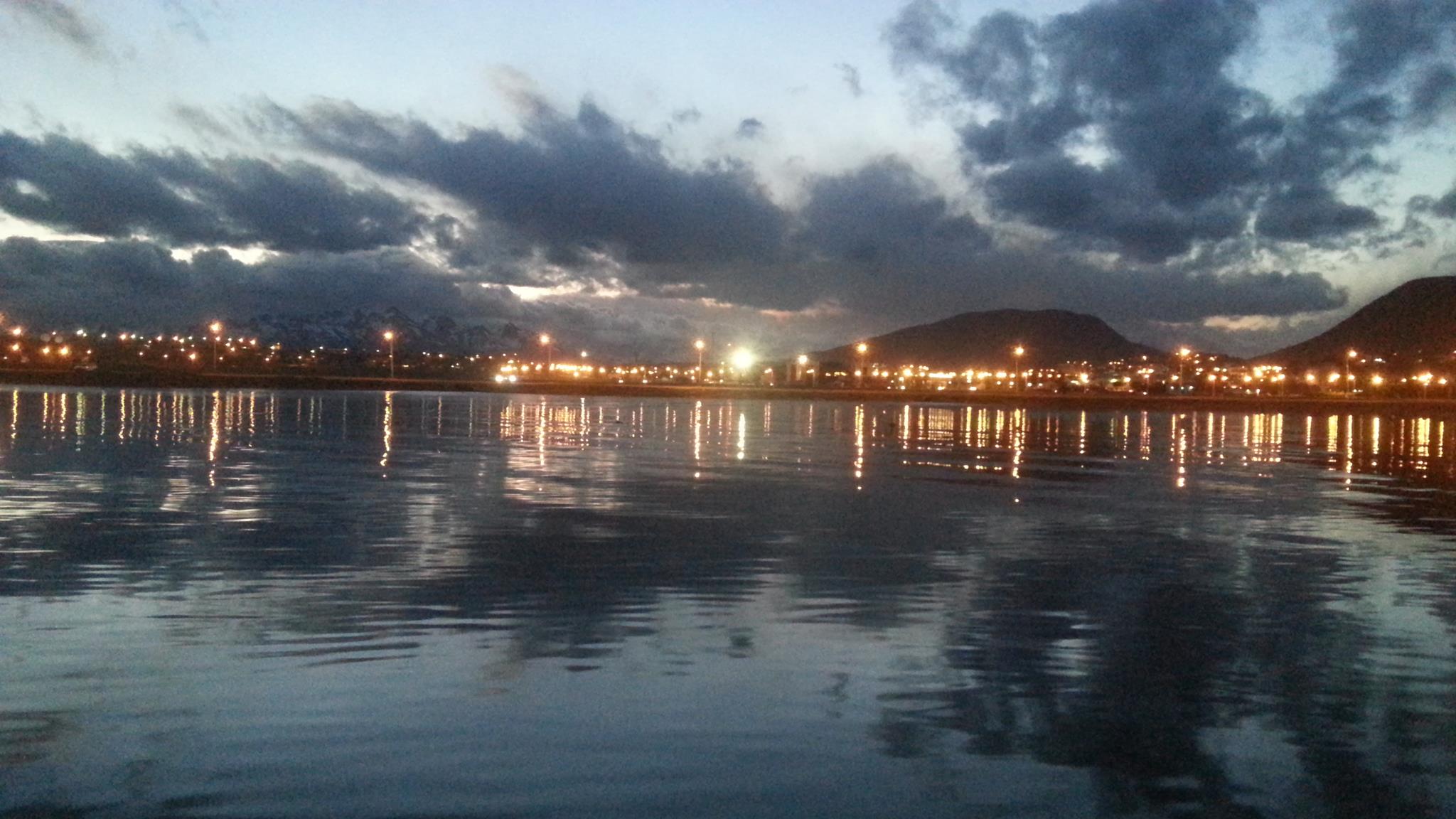
After the takeover, Wenzel will be returning home for a well-deserved Christmas holiday and a rest following the long journey from Hamburg to Africa and on to Ushuaia (photo) in Brazil. Lara Winkler, Fabian Reith, Jan Kannengießer and Volker Janke will be leaving the ship as well. However, this week the film team from the Topas production company will be coming aboard to begin with the filming of the planned TV-documentation “400 Jahre Kap Hoorn”(400 Years Cape Horn) and “Silberkondor über Feuerland” (Silver Condor over Tierra del Fuego).
Upon arrival in Ushuaia we had bright sunshine and cool temperatures of 4°C with winds of 40 knots. The winds calmed down over night. Arved Fuchs will be giving a detailed report in the coming days.
Finally on board again! It is a great feeling to see the “Dagmar Aaen” in the marina of Ushuaia. As if it could be completely taken for granted, the ship has travelled 9.000 sea miles since she left Hamburg on the 5th of August. Volker, who was responsible on board during the whole journey – most of the time as captain – is leaving for a well-deserved holiday. He will be returning on board at the beginning of January for the journey to the Antarctic.
My thanks go not only to Volker at this point, but to the whole crew who brought the ship here safe and sound. The ship is in good condition. By looking at the “Dagmar Aaen” one doesn’t notice what she has accomplished. Unfortunately we must go through a lot of paper work for border crossings and outbound clearances, but that’s the way things are. We are now in Puerto Williams in Chile.
We are heading for Cape Horn tomorrow. The weather has been bad till now: stormy and cold. And it is summer here. We have had night frost and it has snowed. Even the locals find this very strange. The weather is supposed to improve as of Sunday. The Chilean Navy has been very helpful and supportive of our film project about Cape Horn. In January, it will be 400 years since Cape Horn was sailed around for the first time. The film production company Topas is making a film documentation on this for ZDF. This is really quite a wild region.
The small yacht club in Puerto Williams consists of an original German Rhine steamship which sunk many years ago. It is now used as a yacht club and yachts from all over the world moor here. It is really comfortable in the Micalvi; there are showers, a bar and common rooms. The walls are covered with flags and souvenirs from widely travelled yachts. But now we are heading for the “Mother of all Capes” – Cape Horn. I will report…
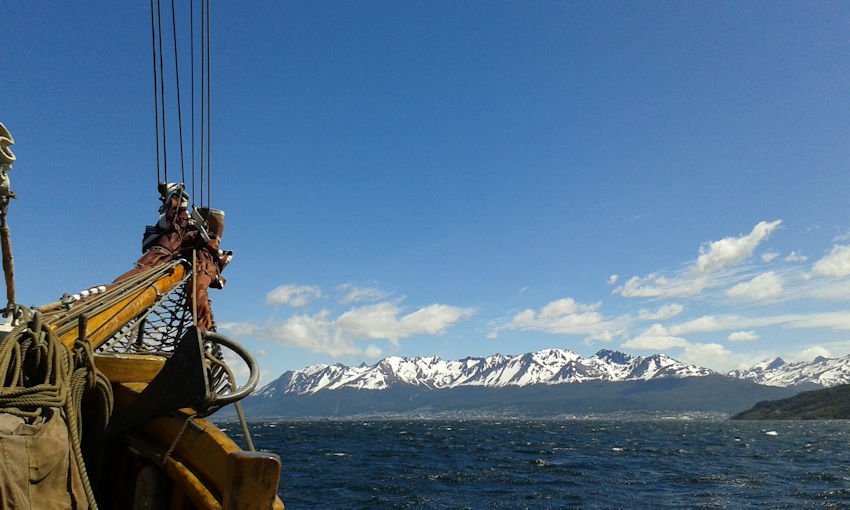
According to the locals here, it is possible to experience four seasons within a few hours in Tierra del Fuego. It’s true. Upon leaving Puerto Williams, the summer sun is shining; on the Beagle Canal we are met with strong winds - typical for the fall. Following that we have wintery driving snow and shortly after that the temperatures rise to a spring-like 7°. The area beyond 54 degrees south has a lot to offer not only regarding the weather.
For example the Chilean hospitality; it is 10 pm in the evening when we arrive in Puerto Toro. The most southerly community in the world lies at 55 degrees and 05 minutes south. There are a maximum of 36 people living here – fishermen, naval units, police and their families. When we arrive, the central pier in the village is deserted – not a single fishing boat. There are only two round-the-world sailing ships – the “Iorana” from Belgium and the “Tari2 (without a national flag on the ship). The head of the marina takes our lines and greets us warmly. His two daughters have painted pictures for Arved. We quickly find out why there is so much space at the pier: The Centoalla (giant crab) fishing season has its summer break.
There are only 17 people left in Puerto Toro – six adults, six children and five policemen. Raul, the police chief, is looking forward to his replacement shortly before Christmas. There is a church here, a school and even a sports hall. Only cigarettes are scarce. Due to the fact that there are no roads leading here, all goods must be brought in by ship. Raul returns home shortly. We have just finished our “mooring beer” when he comes back – in his hand some frozen Centoalla meat. He exchanges this for two packs of fags. The crew can now look forward to a fine dinner. Fabian, the boatswain and cook, prepares a delicious garlic mayonnaise and the feast can begin. In the fishing season from February to November, two tons of giant crabs are caught per ship per day. The centoalla are relatively unspectacular for the Chileans in Tierra del Fuego – in Europe on the other hand this meat, which is similar to lobster, is an almost unaffordable delicacy.
There was another change of crew members on the “Dagmar Aaen” before we left Puerto Williams. Uwe Agnes and Bernd Siering, the two documentary film makers, left the ship for a few days. They had the unique opportunity of travelling on a Chilean naval ship directly to Isla Hornos to film the legendary Cape Horn landside. Matze Steiner arrived on board once again from Hamburg. He travelled here by boat. Louis, a retired banker, brought him here from the Argentine harbor of Ushuaia on his 30 foot yacht named “Austral”. It took five hours under ideal sailing conditions to sail through the Beagle Canal to Puerto Williams.
We are still waiting for permission from the navy to sail around Cape Horn. The excitement is growing on board…
The humming sound is getting louder. It approaches the “Dagmar Aaen” from eastern, circles around the ship and then disappears upwards. On board, however, no one is paying attention to this flying object which hovers in mid-air making a humming noise. This lack of interest has a good reason: We are in the middle of filming. Tim B. Frank is skillfully controlling the drone around the “Dagmar Aaen” by remote control from the shore. Any glance from the crew to the drone or at worst a wave would ruin the footage. The film shots will be part of a documentation which Bernd Siering and Uwe Agnes are making for ZDFInfo.
We are anchored in the Caletta Olla, a perfectly protected bay on the north shore of Beagle Canal. When we arrived here during the night, there were already three yachts in the bay. But they have now left and we can enjoy this magnificent nature around us on our own. Only a few land lines attached to trees prove that Chilean fishermen also use this place to find protection when the weather is bad. In the afternoon we pack our stuff and go off on a hike.
After climbing through rough terrain we have a wonderful view. On the one side there is a lake at the edge of a glacier. On the other side we can see the bay where the “Dagmar Aaen” is at anchor. Above us a condor is circling. We are sure we recognize two sea eagles. More nature is not possible. Lugging up cameras, tripods and the drones has proved worthwhile for the film crew.
Some wonderful nature shots are the result. We can convince ourselves of this in the evening on board when we view the material on the laptop. We are looking forward to the documentation which ZDFInfo are planning to send at the end of January, 2016. We are now heading for the glaciers further west of the Beagle Canal.
In the southern hemisphere of our earth summer has begun. When there are no cold winds coming down from the mountains, we can wear our t-shirts on board. It seems strange right now to think of Christmas. If you take a close look, however, you can find signs of this festive time here in Tierra del Fuego. First of all you have the snow-covered peaks on Isla Navarinho the largest island south of Beagle Canal.
In the Argentine port Ushuaia we discover a small Christmas tree with loads of artificial snow in a store window. On the Isla Hornos at the legendary Cape Horn, the station commander and his family have put up a plastic tree with blinking light chains. On the central square of Puerto Williams – the southern-most city in the world – with its 2100 inhabitants, there even stands a big decorated tree and beside this there is a manger with waist-high wooden figures. Wherever we find a Christmas tree in Argentina or Chile it is a plastic replica of a northern pine although these trees do not grow here.
Micalvi Yacht Club
North-European customs have, therefore, established themselves in the southern-most regions of the world. In some of the windows in the small wooden houses in Puerto Williams there are Christmas garlands hung. And even on the Micalvi there stands a small plastic tree. The Micalvi is an old German Rhine steamer which was sold to Chile in 1928 and which sunk in the seventies in the port of Puerto Williams. The whole ship still lies there. The structures which are above the water are used for the club house of the Micalvi Yacht Club, the southern-most sailing club in the world.
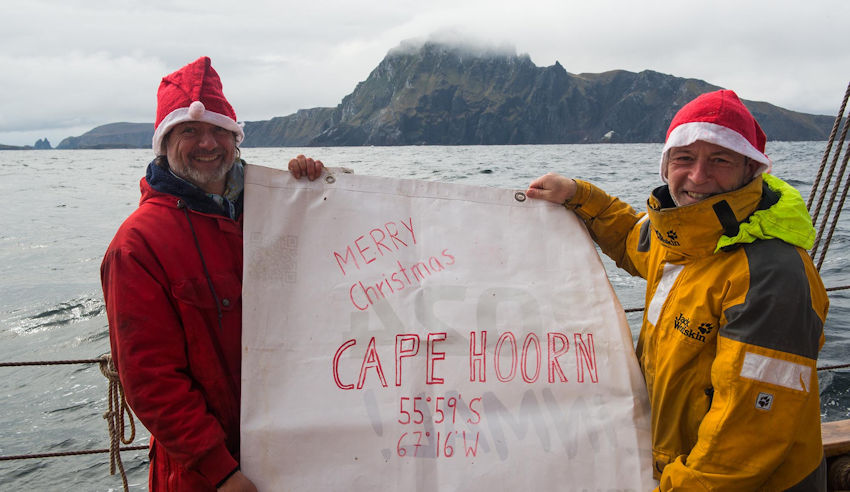
Ships here from all over the world are tied together in groups of up to six. We are going to celebrate Christmas here too. The first indications of the most festive time of the year can already be found on board. Matze has brought two red pointed caps with him Michael is wildly determined to bake Christmas cookies after his mother’s recipe and mulled wine spice has been sighted.
Following extensive maintenance work on the ship, we would all like to enjoy some peaceful and relaxed festive days in the circle of the world-wide family of sailors. There has been a further change of crew on board. The film crew members Thomas and Marcel have left the ship. Arved’s wife Brigitte has come on board and Matze is pleased that his wife Gabi and his son Nick have come to visit us on board the “Dagmar Aaen”.
There will be no Christmas presents this year, but that doesn’t matter because being on board the “Dagmar Aaen” on Christmas Eve in Tierra del Fuego is the biggest present we can imagine.